Born in 1856, Gibson was an obsessive, eccentric genius in the great American poetic tradition of Stephen Crane, Herman Melville and Walt Whitman. He worked around Kalamazoo, Mich., in a number of odd jobs, but his skills as an archtop luthier and woodworker were such that he tried his hand at building musical instruments. His contempt for other instrument makers was immense, as was his belief in himself and his conviction that the sonority and projection of arched tops, backs and rims carved from solid pieces of unstressed tone woods was inherently superior to that of instruments formed from flat sheets and bent strips of tone wood.
In effect, Gibson adapted European violin-making techniques to the construction of mandolins and custom archtop guitars—where the top acted, the back reacted and the chamber resonated. “I don’t necessarily see one as having an advantage over another,” opines Seattle luthier Steve Andersen, whose archtop guitar and flattop designs have been championed by the likes of Bill Frisell and cartoonist-collector Gary Larson. “I started out building a traditional flattop, and in the last 10-12 years I really focused on the custom archtops. To me they’re both very valid instruments.”
“What the archtop guitar does best is make the sound of each string very clear, punchy, powerful and focused,” explains Stephen Grimes, a master luthier operating out of Hawaii who has built custom archtop guitars for George Benson, and is currently collaborating with the jazz guitar legend on new signature models for Ibanez. “The flattop guitar is a very full sounding guitar without a whole lot of projection. If you were to stand 100 feet away and listen to them both, you’d hear the distinct notes of each string on the archtop guitar, whereas the flattop would be little more than mush.”
By today’s standards, Orville’s original instruments, such as the classic Style O archtop guitar, were built like tanks. Orville experimented with different styles of internal bracing, various tone woods and huge hollow necks, trying to enhance the overall sonority and resonance of his instruments until each note could be plainly heard. Ultimately he selected spruce for the top because it was light, malleable and lively—it transmitted vibrations directly across the grain. He used maple for the back and rims because it was hard, dense and stable—it could reflect and sustain tone. Starting with a thick quarter-sawn board, Gibson would sketch a silhouette of the instrument, saw away excess wood, scallop out the insides and shave down the outsides to form a flexible arched diaphragm, graduating the tops and backs by shaving and sanding, tapping the wood as he went along, until he’d achieved the optimum shape, thickness, sonority and sensitivity.
To get in touch with archtop guitar luthier, visit Fine Archtops at www.FineArchtops.com.

Thursday, August 25, 2011

Wednesday, August 24, 2011
The Evolution of Archtop Guitars
When Chip Stern first brought his Johnny Smith Gibson to luthier James L. “Jimmy” D’Aquisto’s Farmingdale, Long Island, workshop in 1973 for a fret job, it was the beginning of a lifetime friendship that cemented my fascination with the archtop guitar, an instrument indelibly fixed in the collective consciousness due to the big band craze of the 1930s, and its role as the instrument of choice amongst jazz guitarists from Charlie Christian on up.
Like many youngsters, my first encounters with archtop guitars took place while trudging my way through the Mel Bay Method for a succession of teachers with bad complexions and big Italian cheesecake guitars, generally the Excel or New Yorker models crafted by the Lower East Side luthier John D’Angelico—D’Aquisto’s mentor. Plucking away on my $35 Danelectro hollow-body electric (a harmonious marriage of prime Formica and Masonite), I was in awe of these larger-than-life instruments, with their warm, penetrating sound—bejeweled as they were with ornate abalone and mother-of-pearl inlays, gold-plated fittings and elegant cream bindings. Following the elder D’Angelico’s death, Jimmy D’Aquisto was defined by that tradition and extended it—a source of both great pride and frustration for this bold, gifted artisan.
“He was torn between that world, and what he thought was right,” according to friend John Monteleone, a master archtop luthier from Long Island with a formidable reputation among players and collectors. “It must have consumed him, because he was a passionate, imaginative fellow, who really had the creative juices flowing. You see, when you begin to wrestle with these materials, you get used to dealing with it according to your experience. So people like Jimmy and I used to think about things a lot from a player’s point of view, and that gives you ideas, and when you have ideas, you tend to want to try them out. Some things may not turn out to be all that good; it’s just as valuable to learn what is wrong as what is right.”
To this end, D’Aquisto was always pushing the envelope. In the mid-’60s he began routing out acoustic tone chambers from solid pieces of maple, then sealed them with a carved spruce top for an instrument that looked and felt like a solid body, but sounded like an amplified acoustic archtop. And by the end of his life, with the Solo, Avant Garde and Centura models, D’Aquisto zeroed in on a more personal sound, feel and aesthetic, replacing those obtrusive plastic pickguards with a sleek ebony finger-rest, experimenting with height-adjustable ebony tailpieces and larger bridges in an attempt to fine-tune the down tension of the instrument’s top and voice through external adjustments. “Instruments back then were not designed to be played the way that you’re playing today,” said D’Aquisto. “They were designed for a specific style of playing. I know. I was there making ’em. An archtop guitar was made to have a penetration and a cutting power that would project. It’s the king of guitars, and there’s no limit to the number of ways you can voice a custom archtop guitar. But while the music’s changed, we’re still employing technologies of the ’30s.”
Veteran luthier Robert Benedetto, whose custom archtop guitars are employed by virtuosos like Jimmy Bruno and Jack Wilkins, the tried and true remains relevant. “The so-called ’30s technology really hasn’t changed,” he asserts. “Those fundamentals still work, and I have yet to see anything, from any makers, myself included, that constitutes a meaningful improvement. I guess that makes me the doubting Thomas of luthiers, and sure, there have been a lot of refinements: the tops and backs are being graduated and more finely tuned now than they were in the past, resulting in a guitar that should mature to have a better voice as it is aged. But I don’t see any radical changes in jazz or playing styles or the instruments themselves.”
Clearly, archtop luthiers differ as to whether the archtop guitar is best regarded as a finished painting or a blank canvas upon which to depict fresh tonal colors. “If you give everyone the same ingredients and recipe to make this guitar, they’re all going to come out different,” concludes Monteleone, bespeaking the enduring originality of this instrument, which like the country that bred it, is equal parts Yankee ingenuity and old-world artistry, dating back to the post-Civil War vision of Orville Gibson.
To get in touch with archtop guitar luthier, visit Fine Archtops at www.FineArchtops.com.
Tuesday, August 23, 2011
Archtop Guitar Building
Trying to build that perfect archtop guitar? Here are some pictures to inspire you:

(From BarkingDogGuitars.com)
(From JoeDragonny.com)

(From Guitarrez.com)
Monday, August 22, 2011
Custom Archtop Artistry
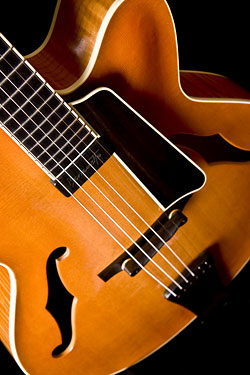
Archtop guitars fall into two groups: acoustic and electric. Acoustic archtop guitars are sometimes amplified with a floating pick-up, and electric archtop guitars have pickups set into the body.
Traditionally, great archtop guitars are built around a top and back that are carved, inside and out, into thin arched surfaces, which produce exceptional volume and tone. This process takes a lot of time by a highly-skilled craftsperson. Needless to say, these great archtop luthiers don’t come cheap. It is not a coincidence that these Rolls-Royces & Bentleys of the archtop guitar world cost more than Chevrolet & Fords of the archtop guitar world.
It is time for the jazz guitar education community to acknowledge the profound influence of guitarists on modern jazz, and to embrace the universal popularity of this instrument.
Most of the custom archtop luthiers in the world of higher jazz education know that the guitar is like the disenfranchised, problem child of the jazz guitar program. There is but one chair in the big band of vocal jazz group for a guitarist. He or she “chonks” away at the chords and battles with the keyboard player for comping duties, or dukes it out with 15 horn players for solo space. Small wonder archtop guitar players often prefer to return to the garage with jam buddies for after-school sessions, with no support, guidance or interference from anyone except mom and pop, who reluctantly contributed the garage space.
There is a short of music and playing situations in schools for archtop guitarists, where the music directors are seldom guitarists themselves. To make matters worse, the archtop guitarists are likely to be interested in genres that the music director is unfamiliar with, and not have the inclination to coach classes that don’t come with a “custom built archtop” repertoire for that instrument.
Today, archtop guitars are largely built by specialized luthiers. If you're looking for a custom archtop guitar, visit Fine Archtops at www.FineArchtops.com.
Thursday, August 18, 2011
The Quest for Acoustic Sound
For the last 60 years, therefore, the archtop jazz guitar has been amplified, with either one or two pick-ups installed, the latter typemaking for a more versatile instrument. Be that as it may, one of the clear object that is good acoustically. But to produce a top-quality acoustic archtop is the sternest test of any luthier, experienced or otherwise. Having been to the workshops of highly regarded builders such as Ribbecke, Benedetto, Campellone Grimes and Monteleone, I know that everyone of these luthiers is deeply absorbed in making archtops of the highest caliber, acoustically speaking. Benedetto’s 25th Anniversary Model, Monteleone’s exquisite “Radio City” model, Campellone’s “Special”, Grimes’ “35th Anniversary Limited Edition” and Ribbecke’s “25th Anniversary Edition” all come without pick-ups (though one can be added if desired). One only has to consult books like “The Acoustic Guitar” by N. Freeth and Charles Alexander, or “The Blue Guitar” by Ken Vose to reveal the extent to which luthiers are committed to producing beautiful acoustic instruments.
Yet the unassailable fact remains that the vast majority of jazz guitars are supplied with pick-ups. Some luthier builders employ one floating pick-up; others have one or two builtin. The key point here is that market conditions determine the nature of guitar, both its shape and looks, as well as its individual appointments.
Looking for an archtop guitar luthier? Fine Archtops hosts a directory of guitar makers who can make your dream custom archtop. Find the list at www.FineArchtops.com
Wednesday, August 17, 2011
Acoustic Archtop Guitar
The archtop guitar is largely synonymous with jazz in the context of public performance, in a small group line-up. In pre-amplification days fine archtops were somewhat large in body size and parallel (or near parallel) braced. In rhythm playing in the big bands this formula gave the archtop guitar a cutting edge and the big sound guitar players wanted. When instruments were fitted with pick-ups and amps, it was given to players to put the jazz guitar on the musical map as a solo instrument. Not only was the archtop guitar now able to hold its own in the big bands as a solo instrument, it was only a matter of time when the fine archtop guitar would fit in with diverse musical configurations. But whether in solo performance or in the midst of bands, the archtop guitar needed amplification if it was to be heard in the public forum.
Wednesday, August 10, 2011
Making an Archtop Guitar
When you’re trying to make an archtop guitar, keep the following in mind:
- Read Robert Benedetto’s “Making an Archtop Guitar,” which is the leading authority for building custom archtop guitars.
- Don’t let the implementation of arched plates set you back. Perform the need intermediate steps and don’t skip over anything!
- Look online for videos of archtop guitar building to see if any inspire you.
Subscribe to:
Posts (Atom)