For lovers of archtop guitars, there are few better ways to get your fix than YouTube. There are a wide variety of archtop guitar videos out there, from videos of guitars being built to being played. Here are some of our favorite ones:
The Monarch Archtop Guitar Demo from John Buscarino.
Steve Marchione 16" Archtop Guitar.
Bill Comins 17" Concert Archtop Guitar.
The secrets of archtop making and Italian pizza from John Monteleone.

Showing posts with label archtop makers. Show all posts
Showing posts with label archtop makers. Show all posts
Tuesday, September 18, 2012

Thursday, August 16, 2012
Meet Archtop Luthier Jef Demers
 | |
| Jef Demers |
Here's what Guitar Noize had to say about his work:
I’d never heard of Demers Guitars before but I stumbled upon this very fine looking guitar and was intrigued. At first I was drawn in by the Bigsby Trem and P-90 pickups but there is far more to this guitar like the AAA Flame Maple top on a Swamp Ash body, Mahogany neck with Ebony fretboard and laminated Carbon Fibre headstock with Sperzel TrimLock tuners.Visit Jef Demers' page on FineArchtops.com.
Thursday, July 26, 2012
Guitar Luthier Doug Harrison Joins Fine Archtops
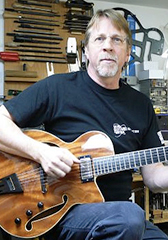 |
| Guitar luthier Doug Harrison |
Doug Harrison began building archtop guitars in 1992, and his work is nothing short of spectacular. His work has appealed to the most discriminating guitar players and collectors, as only the best products are used in his products, and the sounds are incredible and the instruments effortless to play, thanks to Doug spending years on examining the dimensions of sound production.
For more information on Doug Harrison and other luthiers, visit www.FineArchtops.com.
Thursday, June 28, 2012
The Rise, Fall, and Rise of the Archtop
When Lloyd Loar joined Gibson in 1919, the guitar world was turned on its head. Loar, who himself was not a luthier, but was a part-time musician and consultant to companies like GM and others, came in and took the famous guitar company by storm. Loar is credited with creating much of what today's archtop guitars feature: the arched top, floating bridge, and f-holes. Musicians of the time loved them.
Of course, different waves of music pushed different types of guitars into the spotlight, and in the 1950s, solid guitars took over, and many musicians left archtops behind. When compared to some of the more sleek solids, the archtop looked much larger and old fashioned.
Fortunately, the archtop would experience a renaissance. In the 1990s, some musicians started to come back to the instruments, and their popularity began to rise once more. Like the saying goes, "Everything old is new again." Archtop guitars are no different. Still today, they're sought after instruments, and luthiers are booked years into the future to build custom guitars for interested customers.
Are you thinking of having an archtop guitar built on your behalf? Check out Fine Archtops and get in touch with a skilled archtop guitar luthier today.
Of course, different waves of music pushed different types of guitars into the spotlight, and in the 1950s, solid guitars took over, and many musicians left archtops behind. When compared to some of the more sleek solids, the archtop looked much larger and old fashioned.
Fortunately, the archtop would experience a renaissance. In the 1990s, some musicians started to come back to the instruments, and their popularity began to rise once more. Like the saying goes, "Everything old is new again." Archtop guitars are no different. Still today, they're sought after instruments, and luthiers are booked years into the future to build custom guitars for interested customers.
Are you thinking of having an archtop guitar built on your behalf? Check out Fine Archtops and get in touch with a skilled archtop guitar luthier today.
Tuesday, June 26, 2012
Archtop Guitars from our Facebook Community
Last week, we put out a call for those in the Fine Archtops Facebook community to post a photo of their favorite archtop guitars. We got a great response, and would like to put the spotlight on some of the guitar photos that were posted. As always, if you're on Facebook, we'd love for you to like the Fine Archtops page and share your own guitar photos and stories.

This 15-inch Elm and Purpleheart belongs to Daniel Whitt.

Peter Warmington's custom-built archtop. One of its unique features is a trilogy bridge that can drop the low string from E-D-C, and can also drop other strings a half step.

A 2001 Gibson ES165 Herb Ellis, belonging to Dennis Shea.

Maurício MI's Benedetto 16-B.
Are you a fan of archtop guitars, or are you looking to have a custom archtop built? Check out the Fine Archtops website at FineArchtops.com.
This 15-inch Elm and Purpleheart belongs to Daniel Whitt.
Peter Warmington's custom-built archtop. One of its unique features is a trilogy bridge that can drop the low string from E-D-C, and can also drop other strings a half step.
A 2001 Gibson ES165 Herb Ellis, belonging to Dennis Shea.
Maurício MI's Benedetto 16-B.
Are you a fan of archtop guitars, or are you looking to have a custom archtop built? Check out the Fine Archtops website at FineArchtops.com.
Wednesday, June 20, 2012
NEW! Archtop of the Week
If you're reading this blog post, chances are, you're a big fan of archtop guitars. So are we, and we're always looking for ways to bring more interesting archtop guitar-related content to the Fine Archtops website, as well as our communities on Facebook and Twitter. One interesting suggestion came in from a user on Facebook, suggesting that we have an "archtop of the day/week/month" feature.
We love the idea, and we're going to run with it.
So here's what we're going to do. Each week, we'll put out a call to our friends on Facebook and Twitter to provide us with a photo or two of an archtop guitar they own, as well as a bit of backstory on how they ended up with the guitar. Then we'll publish the story on our blog as "Archtop of the Week!"
Interested in getting started today? You can post on our Facebook timeline, send us a private Facebook message, or tweet us to tell us more about your archtop.
We love the idea, and we're going to run with it.
So here's what we're going to do. Each week, we'll put out a call to our friends on Facebook and Twitter to provide us with a photo or two of an archtop guitar they own, as well as a bit of backstory on how they ended up with the guitar. Then we'll publish the story on our blog as "Archtop of the Week!"
Interested in getting started today? You can post on our Facebook timeline, send us a private Facebook message, or tweet us to tell us more about your archtop.
Thursday, June 7, 2012
Bob Benedetto: A Just Jazz Guitar Interview
After his 60th birthday, Bob Benedetto wasn't content to retire and take it easy. Instead, he saw this milestone as the perfect opportunity to start a new journey; to strike out on his own once more and make guitars by himself.
Benedetto's relationship with Fender lasted seven years, and Bob said that he and the Fender family separated on very good terms. The opportunity was there for Benedetto to have his own manufacturing facility, and he felt he had to take it.
But will Bob continue making his own custom archtop guitars?
"In our new facility in Savannah, Georgia, I have set up my own personal workbench in my own corner of the building, where I will continue to make unique instruments as I always have," Benedetto said.
For fans of Benedetto's guitars, that news is certainly music to their ears.
You can read more of Just Jazz Guitar's interview with Bob Benedetto in the February 2007 issue.
Benedetto's relationship with Fender lasted seven years, and Bob said that he and the Fender family separated on very good terms. The opportunity was there for Benedetto to have his own manufacturing facility, and he felt he had to take it.
But will Bob continue making his own custom archtop guitars?
"In our new facility in Savannah, Georgia, I have set up my own personal workbench in my own corner of the building, where I will continue to make unique instruments as I always have," Benedetto said.
For fans of Benedetto's guitars, that news is certainly music to their ears.
You can read more of Just Jazz Guitar's interview with Bob Benedetto in the February 2007 issue.
Tuesday, May 29, 2012
Excerpts from Just Jazz Guitar's Interview with Steve Grimes
Steve Grimes is an accomplished archtop guitar luthier who some might say is living the dream. Originally starting his business in Washington State, Steve relocated to Kula, a small town situated 4,000 feet above sea level in Maui, Hawaii. This higher elevation and more consistent climate helps keep his shop dehumidified, which benefits his guitars tremendously.
Just Jazz Guitar asked Steve a little bit about his work in Maui.
Just Jazz Guitar asked Steve a little bit about his work in Maui.
JB: For your archtop bodies, what woods do you select for the top, sides, and back?
SG: For thirty-five years, I've been making archtop instruments almost exclusively from spruce and maple. Recently, hwoever, I've been making archtops with koa sides and backs. Koa is a very wonderful tonewood, with great variety in sound-producing characteristics.You can read more from Steve's interview in the August 2007 issue of Just Jazz guitar magazine. And if you're interested in learning a bit more about Steve on the Web, you can visit his archtop luthier page on the Fine Archtops website.
Wednesday, May 16, 2012
Just Jazz Guitar Q&A with Luthier Bill Moll
 |
| Luthier Bill Moll |
Over the years, Just
Jazz Guitar has published several great interviews with many of the archtop guitar
luthiers featured on FineArchtops.com.
In August 2003, luthier Bill Moll was
interviewed by the magazine, and talked about his early days building archtop
guitars and his building technique at the time of the interview.
Here are some quotes from the five-page feature.
On the state of the guitar-building business at that time:
It’s always been my philosophy that you have to keep guitars in an affordable range. While many guitar prices have gotten astronomical, I can’t help but think that value has kept us thriving. I’ve noticed now that Guild has come out with a new model in a lower price range, (Jim) Triggs has come out with one, and (John) Buscarino came out with a laminated model in this range a while ago. It seems like everyone is realizing that we need to back up here and answer the call from the marketplace. It really had to happen, it was just a matter of time.
On differentiating himself from other luthiers:
Well, there’s value, track record and reputation, but our most frequent complement is on our sound. Right now, we are truly in the golden age of lutherie. There are more good makers than ever before. In fact, at least year’s New York show, I looked at the roster and about 75% of the names were unfamiliar to me. Higher-priced builders now have to compete with these makers who are building outstanding guitars and extremely high prices get more difficult to justify. Many of these new folks will have a tough time building recognition in the crowd, but there are several who will be contenders for many years to come.
On laminate vs solid-carved guitars:
I cut my teeth hand-carving violins and bows, so I never wanted to work with “plywood.” It wasn’t until I was approached to build a guitar for John (Pizzarelli) that I even considered it. John is all over the world and really has to have the climatic stability of laminated plates. Solid carved plates give me the ability to “sculpt” an instrument’s sound – to voice and tune the instrument, but the laminates sound a lot better acoustically than I thought they would at first. They also make it possible to build in a price range that people can more easily afford.
Friday, May 11, 2012
Just Jazz Guitar Talks with Gary Zimnicki
I didn't know anything about setting up the neck. A friend loaned me a guitar book. The last twenty pages covered how to build your own guitar, including some basic information about fret spacing. This was in 1976 and 1977. My first guitar was terrible, but playable.
Archtop guitar luthier Gary Zimnicki
- - - Gary Zimnicki on his first guitar

In November 2000, Just Jazz Guitar ran a great interview with renowned archtop luthier Gary Zimnicki. In the four-page interview, Zimnicki talked about his early days building archtop guitars, and his building techniques. Gary was very honest about his progression as an archtop luthier, and it's why he's become one of the world's best.
A few quotes from the interview:
On his early guitars:
They had a good sound, but looked awful.The writer, Mark A. Miller, on Gary's creations:
While visiting Zimnicki's shop, I had the privelege to try two completed 18-inch archtop guitars, a sunburst and a blonde. The sound holes on these guitars were located farther outboard than is commonly seen. Gary often places the holes outboard, allowing the maximum area of wood in the top to vibrate uninhibited. He feels that this contributes to a rich, full sound. These guitars were fabulous players with strong power sound. How I envied the lucky owner of the blonde! The sunburst model was also breathtaking, with a red spruce top, quilted maple back and sides, and maple binding.On meeting renowned luthier James D'Aquisto:
He (Gary) had always admired D'Aquisto as a great builder and as a pioneer in modern archtop design. Jimmy talked with Gary and encouraged him to try building an archtop. "Don't be intimidated," he said. With this encouragement, Gary bought the needed wood at the show, and within a year had completed his first archtop guitar. He still has it and keeps it for sentimental reasons.
Tuesday, May 8, 2012
John Monteleone Interviewed by Just Jazz Guitar
 |
| Archtop luthier John Monteleone |
On whether the design potential of the classic archtop guitar has been fully realized ...
John: There may yet be some areas to look into. If I were to wear a lab coat and be financially endowed by some illustrious patron, I could explore various avenues to improve on some aspects. The guitar history is still quite young, but I would say that the main parameters of the guitar have been established already. And when it comes down to it, the archtop must have certain parameters; it must be playable for example. Guidelines must be followed in order to make a guitar successfully.
On tap-tuning the top and back plates ...
Tap-tuning is misleading when people believe that luthiers tap-tune an instrument. That means that you are tuning a specific piece of wood up to a certain pitch. For me, that does not allow for that individual piece of wood to emerge at its best possibility for tonal quality because it does not allow for a lot of things. It does not allow for density or weight, and no two pieces of wood are going to be the same. Everyone knows that. The frequency in the wood is going to vary. When you work with wood, you become aware that it is beginning to vibrate and to pulse in a manner that is familiar to you. At that point, you know that that piece of wood is alive; it starts to shimmer. When I am tapping, it is not so much for frequency, but for the quality of tone, a resonance factor.
On plastic vs wooden bindings ...
I use both for different reasons. When it comes to it, I can do without the inlay, but the customer cannot. The inlays do not make the instrument; they adorn it. I prefer to use wooden bindings because I have had to repair so many guitars with plastic bindings which have a limited lifespan.
The interview isn't online, but you can order the issue of Just Jazz Guitar it's in by clicking here.
Friday, January 13, 2012
Ryan Thorell joins Fine Archtops

From his Cache Valley, Utah one-man shop, Thorell operates
Thorell Guitars. It's been a love of his since he was 13, when he built his
first guitar. Since then, he has become an accomplished jazz guitarist and
teacher, and has studied under notable luthiers such as Tim Gonzalez and Tom
Ribbecke.
For more information about Thorell and Fine Archtops, visit www.FineArchtops.com.
Archtop Guitars from FineArchtops.com
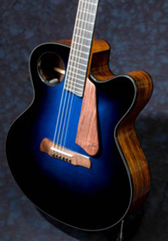 Archtop guitars have a long, rich history and a large following. First introduced in 1936, these guitars have provided jazz guitar enthusiasts with a unique handmade look and sound, though most modern archtop guitars from major guitar brands are now mass-produced.
Fine Archtops, a website created by archtop guitar connoisseur Steve Wagner, aims to connect luthiers (those who create archtop guitars) with those who want to order a quality, handmade archtop guitar. By clicking the "Archtop Luthiers" link on the website, you can view luthiers from across the North American continent.
Check out the Fine Archtops website today if you're looking to have a custom archtop guitar built for you or someone you know.
Wednesday, January 11, 2012
1945 Levin Archtop Guitar Shown & Played
Archtop guitar enthusiasts who are fans of the guitars from the 1940s will get a lot of enjoyment out of this. A YouTube user purchased a 1945 Levin archtop (originally built in Sweden) at an auction and decided to record a video to show it off to the world. The song he chose? "Wildwood Flower," by Mother Maybelle Carter.
Wednesday, December 28, 2011
Advertising for Archtop Guitar Luthiers
Hey, archtop guitar luthiers -- interested in acquiring more leads? Wish you could advertise to potential archtop guitar customers who want a hand-made guitar, but don't know where to start?
Having your biography placed on FineArchtops.com ensures that you'll be found by anyone searching the Web for archtop guitar luthiers. Not only that, but you'll be listed along with the best of the best -- the most well-known and well-respected archtop luthiers on the North American continent.
Click here to begin the sign up process. A monthly subscription is $35 a month, and allows you to place a short bio on FineArchtops.com, as well as link to your website (if applicable).
Having your biography placed on FineArchtops.com ensures that you'll be found by anyone searching the Web for archtop guitar luthiers. Not only that, but you'll be listed along with the best of the best -- the most well-known and well-respected archtop luthiers on the North American continent.
Click here to begin the sign up process. A monthly subscription is $35 a month, and allows you to place a short bio on FineArchtops.com, as well as link to your website (if applicable).
List of Guitar Luthiers
Archtop guitar luthiers are a rare breed. Only 100 or so of these talented guitar makers are located in North America, and not many are easy to find with an online search. If you want an archtop guitar built, how do you find a qualified luthier?
Easy -- FineArchtops.com. Fine Archtops is a website where luthiers and potential customers can connect in order to create the archtop guitar of someone's dreams. The website is more than just a list of guitar luthiers -- it offers a bio about the luthier and links to that individual's website (if one exists). In addition, Fine Archtops also helps archtop guitar enthusiasts find the right accessories.
Visit Fine Archtops today to get started on building your new archtop guitar!
Easy -- FineArchtops.com. Fine Archtops is a website where luthiers and potential customers can connect in order to create the archtop guitar of someone's dreams. The website is more than just a list of guitar luthiers -- it offers a bio about the luthier and links to that individual's website (if one exists). In addition, Fine Archtops also helps archtop guitar enthusiasts find the right accessories.
Visit Fine Archtops today to get started on building your new archtop guitar!
Archtop Guitar Makers
Archtop guitar enthusiasts often enjoy the pastime of collecting guitars as well as playing them. Often times, however, it's difficult to find archtop guitar makers, especially ones whose work you like. That's why we created FineArchtops.com, to connect archtop guitar devotees with luthiers who custom craft these guitars.
 When you visit FineArchtops.com, you're presented with 25 different luthiers who have chosen to make themselves available to archtop guitar lovers. Being enthusiasts themselves, they understand how difficult it is to find the artisans who create these beautiful instruments, and jumped at the opportunity to connect with fellow players and collectors.
Visit the Fine Archtops website at FineArchtops.com to get started on your journey today!
 When you visit FineArchtops.com, you're presented with 25 different luthiers who have chosen to make themselves available to archtop guitar lovers. Being enthusiasts themselves, they understand how difficult it is to find the artisans who create these beautiful instruments, and jumped at the opportunity to connect with fellow players and collectors.
Visit the Fine Archtops website at FineArchtops.com to get started on your journey today!
Friday, December 16, 2011
What We Do at Fine Archtops
Let's say you want a custom, hand-carved archtop guitar created. How would you go about doing that? Like most, you might search for someone who makes these types of guitars using a search engine. But there are many websites that aren't the official websites of archtop luthiers, and you might spend hours, if not days, searching for someone who can create the guitar you want. And when you finally find that person, they might be too busy! There has to be a better way, and there is -- Fine Archtops.
On the Fine Archtops website, you're connected with archtop guitar luthiers and their websites. Because we've partnered with these luthiers to list their bio and information on our website, we know the information is current. By following the link to the luthier's website, you'll be able to get in touch with them about building the archtop guitar of your dreams.
Visit the Fine Archtops website today, browse around and get to know the luthiers we've partnered with to help bring more archtop guitars into the world!
On the Fine Archtops website, you're connected with archtop guitar luthiers and their websites. Because we've partnered with these luthiers to list their bio and information on our website, we know the information is current. By following the link to the luthier's website, you'll be able to get in touch with them about building the archtop guitar of your dreams.
Visit the Fine Archtops website today, browse around and get to know the luthiers we've partnered with to help bring more archtop guitars into the world!
Wednesday, December 14, 2011
Archtop Guitar Accessories
 If you're an archtop guitar enthusiast, you know that the guitar is just part of the overall experience when you're playing and performing. That's why we've added an Archtop Accessories page to the Fine Archtops website.
We've linked to several companies who sell accessories like jazz amplifiers, speakers, pickups, cables, effects, strings, cases, and many other types of archtop guitar accessories.
Click here to visit our Archtop Accessories page, or give us a call at 612-366-7120 if you want to add another archtop guitar to your collection!
Sunday, September 4, 2011
Archtop Guitar Market
The evolution of the archtop acoustic guitar has made a lot of sense. It was designed for acoustic rhythm volume back in the 20's, and stayed that way until amplification opened the door to many other options. At that point archtop remained a mainstay only in jazz, but were fitted with pickups, rendering the original form pretty much obsolete.
Decades passed, and eventually both archtop luthiers and guitarists became interested in archtops again as an instrument style in its own right. Not because it was necessary for something anymore, but because it was desirable as a thing of aesthetic beauty and a vehicle for the craftsman's vision to be expressed. But now, because the archtop guitar's former musical niche was no longer an overriding concern, archtop luthiers tried new things - exploiting and tweaking the platform to see how it could sound if different variables were modified from the original classics.
And so here we are. At this time the archtop guitar market offers just about everything: Classic rhythm machines that hearken to yesteryear, with parallel bracing and lots of midrange volume; "modern" sleek touch-sensitive parlor instruments that flit between the sonic territories of steel flattop and nylon, landing in some unique hybrid place. Traditional looking things; outlandish things.
They run the gamut described above. In the future, it would be great to see some really new archtop acoustic guitar design elements and a bit less focus on slaying the customer with overwhelming aesthetic details. It has caused archtop guitars to enter the realm of the luxury item
Decades passed, and eventually both archtop luthiers and guitarists became interested in archtops again as an instrument style in its own right. Not because it was necessary for something anymore, but because it was desirable as a thing of aesthetic beauty and a vehicle for the craftsman's vision to be expressed. But now, because the archtop guitar's former musical niche was no longer an overriding concern, archtop luthiers tried new things - exploiting and tweaking the platform to see how it could sound if different variables were modified from the original classics.
And so here we are. At this time the archtop guitar market offers just about everything: Classic rhythm machines that hearken to yesteryear, with parallel bracing and lots of midrange volume; "modern" sleek touch-sensitive parlor instruments that flit between the sonic territories of steel flattop and nylon, landing in some unique hybrid place. Traditional looking things; outlandish things.
They run the gamut described above. In the future, it would be great to see some really new archtop acoustic guitar design elements and a bit less focus on slaying the customer with overwhelming aesthetic details. It has caused archtop guitars to enter the realm of the luxury item
To get in touch with archtop guitar luthier, visit Fine Archtops at www.FineArchtops.com.
Subscribe to:
Posts (Atom)